
Smart water management that pays for itself
Helophyte filters – reed bed purification systems – are robust, reliable, and require hardly any maintenance. But their greatest asset is often less well known: they deliver high-quality purified water that can be perfectly reused for toilet flushing, cleaning, or garden irrigation. This drastically reduces drinking water consumption and turns a reed bed into an investment that pays for itself surprisingly quickly.
The purified water is odorless, clear, and easily meets discharge standards. In a time of rising water prices and increasing periods of drought, every liter of reused water is immediately felt in the wallet. That is precisely why more and more companies, schools, and sports facilities are opting for a reed bed. sustainable and economic solution.
When a reed bed yields the highest financial return
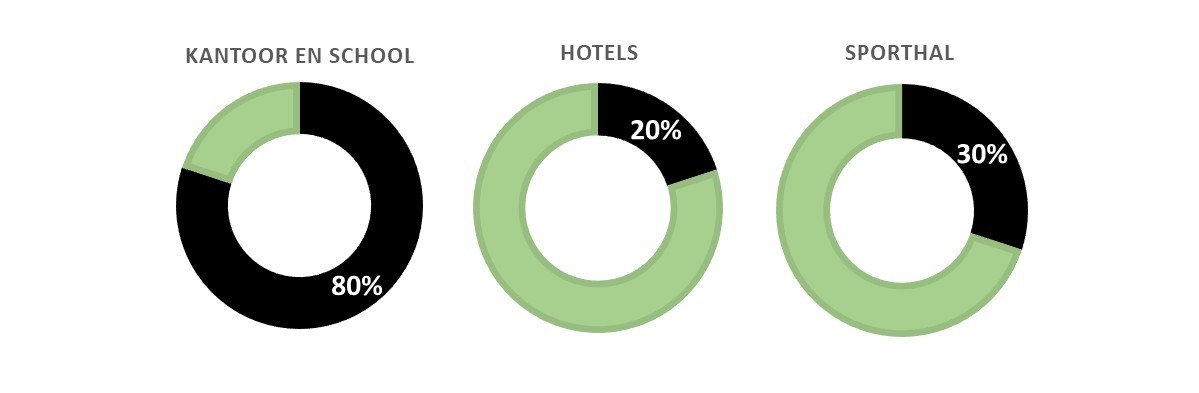
The payback period depends primarily on the ratio of toilet water to other wastewater, the daily volume, and whether a sewer system is present. A different ROI profile emerges in every situation. Below you will find some examples. In the pie chart Below, you can see in black how much water can be reused for toilet flushing in different building types.
1. Locations without sewage systems: full purification, maximum impact
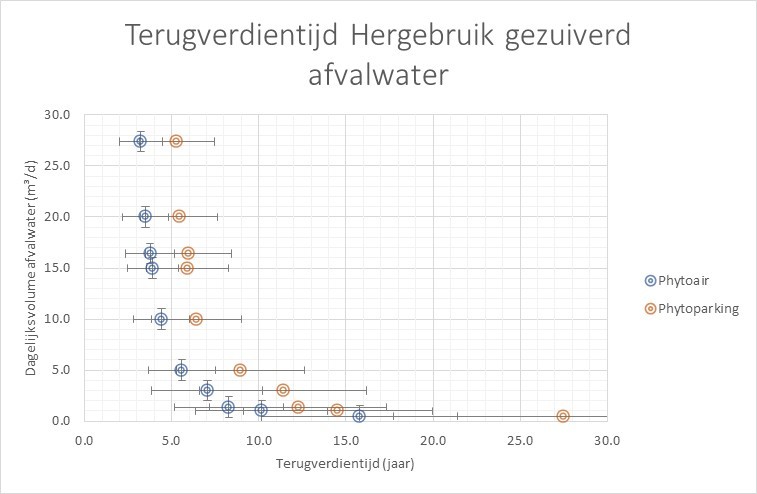
For buildings that cannot connect to the sewage system, there is a Phytoair or compact Phytoparking-system ideal. They are low-maintenance, blend beautifully into the surroundings, and deliver stable purification quality in every season. Below you will find two examples of an office and a sports hall located in a rural setting.
- Offices have a high proportion of toilet water (±80%). As a result, almost all the purified water can be reused. At 3 m³/d, the investment is less than four years earned back; at 20 m³/d the ROI is approximately two years.
- Sports halls have a distinctly asymmetrical water profile: athletes consume much more shower water than toilet water. As a result, a large volume of wastewater is generated that must be treated when no sewage system is present, while only a small portion – the toilet water, approximately 30% – is suitable for reuse. The payback period of a sports hall which 100% purifies alval water remains interesting nonetheless because of the high daily flow rates. With a daily consumption of 27 m³ sufficient drinking water is saved to the installation in approximately five years to earn back.
2. Locations with sewage systems: demand-driven purification for a lower investment
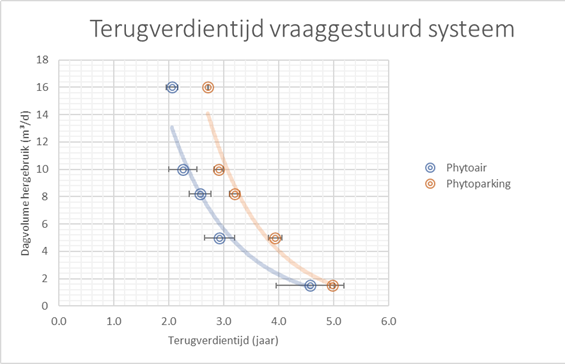
When a sewage system is present, only the portion that can effectively be reused is treated. That makes the installation smaller, cheaper, and payback faster. Below you will find two examples of a school and a hotel located in an urban environment.
- Schools usually have a water profile that is strongly determined by toilet water (up to 80%). With a demand-driven system that only purifies this part, the payback period is around 5 m³/d. three years.
- Hotels have high shower consumption and relatively little toilet water (±20%). By purifying only that toilet water, the installation remains compact. With a total volume of 10 m³/d and 1.5 m³/d of toilet water, the payback period is approximately five years.
3. Additional benefit: water security during dry periods compared to rainwater storage
The legislator requires Flemings to install rainwater tanks, but these often stand empty precisely during dry periods. A reed bed, on the other hand, offers a stable source of reusable water. In addition, we hear in the media that the groundwater levels remain structurally low in Flanders. A reed bed can indirectly help with this. When treated wastewater is used for toilet flushing or watering the garden, rainwater remains available to infiltrate. A reed bed also offers an important solution for high-rise and other buildings with limited roof area. These buildings cannot collect sufficient rainwater to support their water consumption. By reusing treated wastewater, a second, much more reliable source of water, independent of the amount of rain falling on the roof. Often, rainwater and treated wastewater can complement each other, as is being investigated in the COOCK project Waterwijzer.
The payback period of your system depends on:
- The building's water profile — ratio of toilet water for reuse vs. total volume
- The daily throughput — the higher the volume, the faster the savings
- Presence of sewerage — full treatment or demand-driven system
- Drinking water price and consumption intensity
ROI Rule of Thumb:
If rule of thumb it applies that a demand-driven system has a payback period of approximately four years with a minimum daily consumption of 1.5 m³. For a system that purifies the entire wastewater, the payback period is between three and eight years from a daily flow rate of 5 m³.